Volunteering Can Improve Your Health
Let’s take a closer look at the health benefits of volunteering and how donating your time can improve your health.
Vermonters are active in their communities and want to help their neighbors. That’s reflected in the large number who volunteer. More than 200,000 Vermonters regularly donate their time—about 40% of residents age 16 and older. Vermont ranks second in the nation for volunteer rates, bested only by Utah.
Why is volunteerism so high in Vermont? Our traditions of local governance and self-reliance are important factors, as residents serve on select boards, school boards, planning commissions, and other local committees. Many community fire departments, search and rescue teams, and ambulance squads also rely on volunteers for staffing.
Health is another factor driving volunteerism in our state. Vermonters who volunteer know that it improves both their physical health and emotional well-being. Assisting people in their communities helps volunteers feel good and stay active, which leads to lower risk of many chronic conditions.
Let’s take a closer look at the health benefits of volunteering and how donating your time can improve your health.
More Exercise and Less Stress
Volunteering gets you out of your house and into the community, which benefits you in multiple ways:
- Increased exercise. Physical volunteer roles like serving in a fire department, building trails, or working at a food bank often include activities such as walking, lifting, and stretching. Such exercise can boost your immune system, prevent heart disease, build or preserve muscle mass, strengthen bones, reduce cholesterol levels, and lower blood pressure. For example, a study found that older adults who volunteered at least 200 hours a year cut their risk of developing high blood pressure by 40%. Volunteering is a way to get more exercise without it feeling like a workout.
- Reduced stress and increased relaxation. Helping others triggers the release of neurochemicals in our bodies like oxytocin, serotonin, and endorphins, which suppress stress hormones and induce a sense of calm. Studies show that volunteers have less chronic inflammation and reduced stress hormone responses, compared to non-volunteers.
- Less risk of anxiety and depression. Volunteering creates opportunities for low-pressure personal interactions and helps people expand their social networks. Connecting with others in the community fights feelings of isolation that can lead to depression. Doing tasks to assist others takes your mind off your personal worries, helping to reduce anxiety levels.
- Better cognitive function. People who volunteer improve their brain health and cognitive functioning, as volunteer roles often involve complex problem solving and learning new tasks. Volunteer activities strengthen neural networks in the brain, helping maintain cognitive function and delaying the onset of dementia. In addition, people who volunteer regularly tend to have a greater sense of purpose and are more satisfied with their lives. Spending time in service to others boosts their feeling of self-worth and pride. This is especially true for retirees who may be experiencing a sense of loss now that they are no longer working full-time.
- Lower mortality risk. The physical and mental boosts provided by volunteering combine to significantly reduce the overall risk of death. Volunteering at least 100 hours per year (about two hours a week) can cut mortality risk by 30%, one study found.
Overall, there’s strong evidence that volunteering is one of the best things you can do to improve and protect your health.
Blue Cross VT Employees Volunteer
With the benefits of volunteering so clear, we encourage our employees to volunteer in their communities. Blue Cross VT supports that by giving each full-time employee eight hours of paid time off per year to do volunteer work for non-profit charitable organizations.
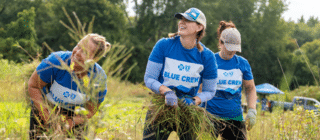
In addition, we recently started an Employee Day of Service, where we close our office for a day so our employees can volunteer in groups. This year, more than 300 Blue Cross VT employees volunteered at 20 charitable food organizations across the state. Employees spent time picking and cleaning produce, sorting and packaging food, and preparing and delivering meals to Vermonters.
Our employees say that volunteering, in a group or individually, is incredibly rewarding.
Julie S. volunteers for several organizations throughout the year, including helping wrap holiday gifts for kids and being a team captain for the American Cancer Society’s Relay for Life. “I like to feel part of something, interacting with others who have similar interests and passions, and working towards shared goals,” she says.
The relay is an event she looks forward to every year. “It raises money for cancer research and brings me a sense of peace and purpose,” Julie says.
Karen G. volunteers at a food shelf in her community a couple of days a week. “Volunteering has certainly helped keep me moving physically—carrying 50-pound bags of potatoes, unloading food orders, and stocking shelves,” she says. “But I think the bigger impact is improving my well-being—being helpful with a true purpose.”
Where to Volunteer
If you would like to become a volunteer, here are some ideas for finding volunteer opportunities in your area.
- Food programs. Volunteers help unload trucks, sort donations, stock shelves, pack food boxes, prepare meals at community meal sites, and deliver food to people at their homes. Some organizations also have gleaning teams that harvest surplus produce directly from farms. Vermont organizations with volunteer programs include Vermont Foodbank, Capstone Community Action, Feeding Champlain Valley, and Northeast Kingdom Community Action. To find a program near you, use the Vermont Foodbank’s locator map.
- Hospitals and health care facilities. Roles for volunteers without medical training include greeters and guides, assisting older patients, family waiting room support, administrative help, and transporting patients. Most Vermont hospitals have active volunteer programs. Medical professionals can volunteer their time to see patients at free clinics.
- Senior assistance. Volunteers are needed to visit seniors and help them with household tasks, as well as drive those without vehicles to medical appointments. Vermont’s five Area Agencies on Aging have volunteer programs.
- United Way programs. A wide range of volunteer opportunities are available from non-profit organizations that are affiliated with the United Way. Each of the United Way programs in Vermont has a volunteer coordination program, which links volunteers to local non-profits.
- Land stewardship and trail maintenance. If you’d prefer to spend time outside, there are many non-profit organizations that rely on volunteers to maintain trails and do other land stewardship work. These include the Green Mountain Club, The Nature Conservancy, and the Lake Champlain Basin Program.
- Housing development. Volunteers work to create new affordable housing, support existing housing communities, and operate shelters. Housing organizations with volunteer programs include Habitat for Humanity, Cathedral Square, and Upper Valley Haven.
Good for You and Your Community
Donating a few hours of your time each month is a great way to give back to your community. Helping your neighbors also improves your health through physical movement, expanding your social network, and engaging your mind in satisfying activities. We hope you’ll join us in volunteering today!